
Summary
- I joined a regional Florida construction management firm and found three related HVAC losses with no dependable system for turning them into the next pursuit’s advantage.
- The fourth pursuit reached the interview in fourth place, 0.63 points behind third and 4.15 behind Skanska.
- Score-gap analysis exposed where weighted criteria, evaluator disagreement, and missing evidence had created competitive separation.
- We discarded about 90 percent of the inherited presentation and rebuilt the argument around buyer concerns, explicit proof, and accountable owners.
- Rehearsal turned the operations team’s knowledge into a coordinated 23-minute presentation with nearly seven minutes of margin.
- The presentation scored 87.30, second in the field, while the gap to Skanska narrowed from 4.15 points in written scoring to 2.00 in presentation scoring.
The Fourth Pursuit
Three weeks after I joined a regional Florida construction management firm, it was selected to interview for a public high school HVAC renovation.
The school district had emailed the shortlist notice on Wednesday. On Thursday morning, shortly after I walked into the office, the Vice President of Strategic Development forwarded it to me.
This was the fourth project in a series of related school HVAC pursuits issued by the same district. The firm had submitted qualifications for all four. It failed to reach the interview round on the first three.
Only the fourth pursuit advanced.
“Ah, shit. Here we go again.”
By March 2026, I had stepped away from commercial business development and was pursuing my own ventures. When a recruiter contacted me about a temporary return, I was apprehensive.
The title was Pursuit & Visual Communications Manager. The actual assignment was to cover the essential duties of the Marketing Manager while the department went through a transition. The compensation gave me very little reason to accept.
Curiosity did.
The position placed me inside a problem I had encountered throughout commercial business development. Capable companies can spend years collecting proposal results without developing a reliable way to learn from them.
During my first two weeks at the firm, I began reconstructing its recent pursuit performance. I calculated the proposals submitted, shortlists earned, and contracts won across 2023, 2024, and 2025.
I was trying to understand the company I had been hired to represent. I needed to know what it pursued, where it competed successfully, and whether its results supported the story it told about itself.
The numbers exposed a stubborn pattern.
The firm increased its bidding activity through 2023 and 2024 while its losses accumulated. It pulled back in 2025, but the conversion problem remained. Changing the number of opportunities it pursued had not changed what happened inside those pursuits.
The proposal archive offered part of the explanation. Previous submissions were being cannibalized. Sections moved from one response into the next, often with a new order, new project name, and updated graphics. Feedback from one pursuit rarely became a documented instruction for the next.
Reordering had become a substitute for improvement.
That approach had already been tested three times in the district’s HVAC program. The firm had submitted on each project and failed to reach the interview round every time. Now the final project in the series had produced a shortlist.
The company had finally earned a seat in the room. Its existing process offered no convincing reason to believe the outcome inside that room would be different.
I decided to build what I called a score-gap analysis.
I was not looking for a prettier way to display the rankings. The ranking only showed where each firm finished. I needed to understand how the evaluators arrived there and which parts of the difference could still be addressed before the upcoming interview.
The three earlier HVAC awards created an unusually useful comparison. They involved the same public buyer, closely related scopes, overlapping competitors, similar evaluation categories, and presentation materials available through public records.
Those similarities allowed me to compare the outcomes across three levels: firm, evaluator, and scored criterion.
At the firm level, I examined how the shortlisted competitors performed across the earlier projects. At the evaluator level, I separated the blended totals to see which committee members created meaningful differences between firms. At the criterion level, I identified where points accumulated, where they disappeared, and what the higher-scoring teams had presented in those sections.
Then I placed the scores beside the actual presentation materials.
The first pass focused on the interview phase of the three earlier pursuits. I reviewed the decks used by the finalist teams, their presentation length, the order of their arguments, the evaluation categories they covered, and the project evidence they placed in front of the district.
The comparison challenged several assumptions immediately.
The strongest-performing presentations were not consistently the largest or the most polished. Some of the shorter decks performed better under the district’s thirty-minute interview limit because their presenters had enough time to explain the information that carried points.
The scorecards also included categories that the firm had been treating as settled during the written phase. Because the solicitation described some information as carrying forward from the written response, the firm had routinely omitted those subjects from its interview presentations.
The evaluators still had points available for them.
Other teams addressed the categories again. This firm did not.
The public record could not explain every evaluator’s reasoning. It could show us where points were available, which competitors had covered them, and which subjects the firm had left for the committee to infer.
On Thursday, I brought the score-gap analysis into the room with the Vice President of Strategic Development, the Vice President of Operations, and the President.
I walked them through the earlier presentation scores and the materials behind them. The discussion moved beyond who had won. We began examining why certain presentation choices were easier to reward.
The analysis also exposed how much remained unresolved for the current pursuit.
There was no settled argument for why the firm should win this particular project. The speaker order had not been assigned according to each person’s strengths. The technical knowledge lived with the operations team, but it had not been organized around the evaluation criteria. The existing PowerPoint carried forward material from presentations that had never produced a shortlist.
I was still too new to manufacture the missing answers. I did not yet know the firm’s strongest comparable projects, its preferred delivery methods, or which operational details would separate a credible project plan from another collection of claims.
The first meeting made those gaps impossible to ignore.
The Vice President of Operations and the President possessed the construction knowledge. The Vice President of Strategic Development understood the pursuit history and the client. I had the score analysis, the presentation evidence, and responsibility for rebuilding the deck.
Those pieces had to become one argument.
The firm had submitted on all four HVAC projects. The first three had ended before an interview. The fourth gave us approximately one week to convert those outcomes into decisions, rebuild the presentation, and prepare the people who would have to defend it.
The shortlist opened the door.
The score-gap analysis showed us where the firm had been leaving points outside it.
Fourth Place Was the Starting Position
Now, this wasn’t my first rodeo.
At Flood Pros of SWFL, I had finished 2024 at 260 percent of quota and generated eight restoration master service agreements covering more than $2 billion in aggregate property value. The public-sector side of my work produced five results that made the value of deliberate capture strategy harder to dismiss:
- Sarasota County, 232449MM: FP was one of three firms recommended for award for water-damage remediation after disaster events.
- Sarasota County Administration Center: After Hurricane Milton extensively damaged the downtown headquarters, FP received a $1.7 million emergency award for the response. Local reporting documented the damage and photographed FP’s catastrophe-response operation at the building.
- Sarasota County, 242586TEG: FP was among the responsive and responsible firms recommended for the county’s prequalified remediation and restoration pool.
- Lee County, B250003CMR: FP was selected as the secondary vendor for disaster environmental remediation.
- Seminole County, RFP-604882-24/LNF: FP was one of two firms recommended from nine submissions for remediation, disaster recovery, and cleanup services, with the other firm being the long-standing incumbent.
The Administration Center award is why those lists mattered. Capture strategy is supposed to make a firm known, qualified, and ready before an urgent need creates the buying decision. Milton did not leave Sarasota County time for a cold introduction. FP was already positioned, and the result was a $1.7 million emergency award.
That experience changed how I read the Estero shortlist. Reaching the interview created access. The score showed how much competitive ground the firm still had to recover.
Thirteen firms submitted qualifications for the project. Six advanced. Skanska led the written evaluation with 84.47 points. Suffolk followed at 81.42, Wright Construction at 80.95, and our firm at 80.32.
We were 0.63 points behind third place and 4.15 points behind the leader.
The response I heard was that fourth place was enough. The firm had reached the interview, and every shortlisted team would now have an opportunity to make its case.
The interview reset the competition, but it did not erase the written ranking.
The 0.63-point distance to third place is where the title of this article begins. In a 100-point evaluation, less than one point separated two competitive positions. Small differences could change the order.
The 4.15-point distance to first place presented a different problem. The aggregate ranking measured the separation without locating it. Before we could close any part of that distance, we had to open the scorebooks and find out where it came from.
What the Score Couldn’t Explain
Mirror Lakes offered the clearest place to begin.
The official scorebook gave the firm 72.08 points and Gulfpoint 83.58, an 11.50-point difference. Those totals came from fourteen parts of the evaluation, each carrying its own weight.
Eleven and a half points looked like a blowout. Opened row by row, it looked more like a map.
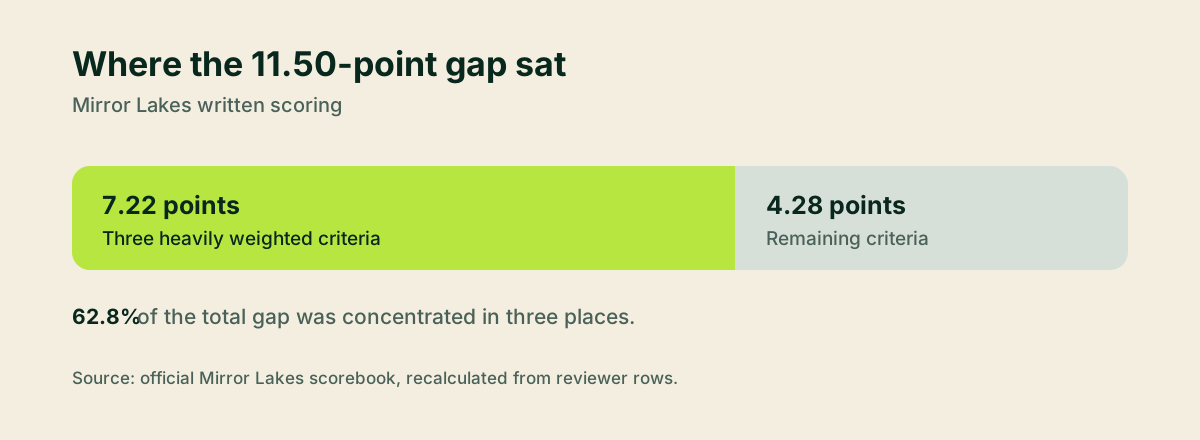
The rows did not carry equal weight. Three of the heaviest written-response criteria were worth 15, 13, and 10 points. Together, those three rows accounted for 7.22 of the 11.50 points between the two firms.
Nearly two-thirds of the gap was concentrated in three places.
A score is the recorded output of an evaluator’s judgment. It is not a complete explanation of that judgment.
The averages made the committee look more unified than it was. Five evaluators scored the eleven main selection-committee criteria. One gave the firm a 5 on all eleven. Another used 5s on three rows and 8s on the other eight. A third used one 5 and ten 8s. The remaining two evaluators assigned 8s throughout.
The comments did not resolve the difference. Some identified concrete weaknesses, including limited evidence from comparable elementary-school HVAC replacements and thin detail on long-lead procurement planning. Several 5s were accompanied only by “Meets” or “Partially meets RFQ requirements.”
Same response. Five readings.
The blended score turned that disagreement into clean decimals. The underlying rows showed that the committee had not read the response the same way. The scorebook could show me that their interpretations differed. It could not tell me why.
It did not prove favoritism. It also could not prove that every firm entered the evaluation carrying the same level of familiarity or accumulated trust.
Public procurement is designed to evaluate competitors against published requirements. That process does not wipe the market clean before the proposals arrive. Competitors bring histories with them. Previous projects, earlier pursuits, known personnel, market visibility, and established brands can all affect how much uncertainty surrounds a firm’s claims.
That is part of capture strategy when it is practiced correctly. The objective is not special treatment. It is to become known, relevant, and credible before the buying decision arrives, while respecting the rules that protect fair competition.
Familiarity does not entitle a firm to points. It can make a firm easier to understand.
Speculating about what any evaluator knew or preferred would not improve the next presentation. Making the evidence explicit would. We needed to reduce the amount the committee had to supply from memory, reputation, or inference.
I ran one narrow what-if test to measure the scale of the divergent ratings. Under a controlled rule, changing five of the 5s moved the firm from 72.08 to 74.84, a gain of 2.76 points. It still finished fourth within the four-firm comparison.
That was a diagnostic test, not an official rescore or a claim that the evaluation was wrong. It answered two useful questions. Could a handful of judgments move the total? Yes. Could they explain the entire 11.50-point gap? No.
Most of the competitive problem was still sitting in the evidence.
The presentations showed what the scorebook could not.
Suffolk and Skanska had explicitly presented 3D scanning, model coordination, and clash detection. The firm had relevant experience with the same methods. During the working sessions, the operations team confirmed that capability and identified a member of the proposed team who could explain it from experience.
The inherited presentation had not made that capability visible.
We had been asking evaluators to award points for something they first had to imagine.
Skanska's sequence offered another useful example. It established knowledge of the existing site before moving into project methodology. That order gave the method a physical context. The committee could see that the proposed approach responded to this facility rather than to a generic HVAC project.
The lesson was not to copy a competitor’s deck. It was to stop making the committee complete our argument for us.
I used Excel and ChatGPT to organize the records and compare the patterns. Operations determined what the firm could truthfully claim, which projects proved it, and who had enough command of the work to answer questions about it.
Score-gap analysis could tell me what the presentation needed to prove. It could not manufacture the proof.
Every proposed slide now had to survive three questions:
- Which scored criterion does this serve?
- What proof makes the claim credible?
- Who can defend it in the room?
Those questions became the frame for the rebuild. Then we opened the inherited deck.
We Kept Ten Percent
We kept about ten percent of it.
That sentence sounds more confident than I felt.
The interview was about a week away. I was preparing to challenge a presentation assembled by people who had spent decades in construction. I was no twenty-year construction veteran. I knew pursuit analysis and presentation architecture, enough to locate missing proof but not to invent construction methods.
I did not tell the room I was terrified. I called the assignment “a little nerve-racking.” That was the professional version.
If I pretended to understand the construction, I could turn the deck into polished fiction. If I stayed quiet because I lacked the tenure, the inherited argument would survive another pursuit.
“I’m the proposal guy, not the construction guy,” I told the room.
My job was to make the unanswered questions impossible to ignore. Operations had to answer them.
Everything had to earn its way back. Much of the deck came from earlier pursuits. New photographs and a new project name would only clean up the same argument.
The district was giving us thirty minutes. Every generic slide would steal time from proving that this team understood Estero High School.
The firm was treating the shortlist as the starting gun for decisions that belonged much earlier in the pursuit. The construction method, constructability argument, cost-saving logic, project-specific risks, speaker ownership, and evidence strategy had not been settled before the interview clock began.
That sequence ran backward from the guidance I had begun studying and adapting into my own process. APMP places competitive positioning and subject-matter expertise in capture. Shipley calls for strategy, team assignments, and storyboards before content begins to harden. Estero forced me to apply both after the shortlist.
The shortlist exposed a process failure whose bill had already come due.
I started outside PowerPoint with a roughly forty-page wireframe organized around the evaluation criteria, the earlier gaps, and the questions the district still had reason to ask. Its unfinished state was deliberate. Polish can make a weak idea look settled. The wireframe left the argument exposed long enough for people to attack it.
The scoring guidelines and strongest slides from the three earlier HVAC pursuits stayed open beside it during the operations sessions. The frame contained more questions than answers. It showed where the answers had to go.
The analysis exposed the questions our previous presentations had failed to answer. Only operations could tell me how to replace air-handling equipment without damaging a school, disrupting its summer programs, or creating new risks for the district. Keeping that boundary intact was quality control.
I stopped asking operations for “content.” I started asking what could go wrong.
The gym produced the clearest example. Its wood floor would remain inside a Florida building while the air-conditioning system was shut down for replacement. Heat and moisture could make the floor sweat and warp.
The operational answer was immediate: keep four commercial dehumidifiers running to control the environment.
That single answer did more than fill a slide. It demonstrated that the team had followed the shutdown past the mechanical room and into the part of the school the district could not afford to replace.
The campus itself was another trap. “Summer construction” sounded like an empty building. Estero would still have band camp, football practice, cheerleading, and activity around the cafeteria, locker rooms, gym, weight room, and band room.
The schedule therefore had to show more than dates. The deck needed to show how workers, students, staff, deliveries, and active spaces would be separated. Badging, controlled access, coordination, staging, and site maps became part of the argument because they answered the district’s real question: how do you execute major work without losing control of the campus around it?
The same thing happened with phasing. “Two summers” could not remain an implication buried in a calendar. Long-lead equipment, controlled shutdowns, temporary conditions, and the handoff between phases had to become visible enough for a presenter to explain and an evaluator to follow.
The proposed team created another constraint. It had already been selected, while the internal project-experience list I inherited was incomplete. The working sessions had to reveal who possessed the relevant experience and which parts of the plan each person could defend.
The earlier review had exposed 3D scanning, model coordination, and clash detection as missing evidence. Operations now put the capability into sequence. Scan the existing conditions before fabrication. Coordinate the model. Find conflicts before crews discover them above a ceiling or beside installed equipment.
One proposed team member had previously worked for Suffolk and understood the technical process from firsthand experience. The capability now had a place in the project plan and a person who could defend it.
That was the pattern across the rebuild. The scorecard identified the obligation. I used the competitive record to sharpen the questions. Operations supplied the consequence, the method, and the evidence. I built the answers into an argument the room could actually deliver.
We built prompts rather than a script. Maps, photographs, short text, and numbered sequences made the project logic visible while the presenters supplied the knowledge. These were important points to speak, not important points to add. A slide could guide the story. It could not create command of the subject after the presentation began.
I spent as many as forty-eight working hours sitting with the scorecards, old presentations, wireframe, project material, and notes from the operations sessions, dismantling and reconstructing the deck. The forty-page frame ultimately contracted into thirty-six slides, including transitions.
Forty-eight working hours might sound heroic. In reality, they measured the cost of introducing the strategy late.
With a functioning capture and pursuit process, the firm could have aligned the proposed team, construction method, project risks, evidence owners, and presentation responsibilities before the shortlist arrived. The technical knowledge already existed. What it lacked was a process for turning that knowledge into one competitive position early enough for everyone to shape it.
Instead, we were trying to get everyone on the same page while I was still building the page.
By Tuesday, thirty-six slides could make the case.
Wednesday would show whether the presenters could.
Now Say It Without Reading
Twenty-three minutes and five seconds.
That was where the stopwatch stopped during the final rehearsal. Six minutes and fifty-five seconds remained under the district’s limit.
The number sounded safe. The performance still had places to break.
Less than a day earlier, the speaking order was still unresolved.
A team can finish the deck before it finishes becoming a team.
The scene would have been funny if the stakes were lower. I was the newest person in the room, holding a stopwatch and telling construction professionals with decades more experience to stop reading the PowerPoint.
Public speaking was familiar territory. I could hear when a point landed, when an explanation wandered, and when a presenter was using the slide as cover.
Thirty-six slides could carry the argument. They could not decide who should say what.
Equal time would have been tidy and wrong. We assigned sections by strength.
The HVAC veteran owned the system methodology. The team member who knew the campus owned logistics, safety, and the separation of construction from students and staff. The budget specialist owned cost controls. The person with firsthand experience using 3D scanning and model coordination owned that technical explanation. A company leader opened the argument and brought it home.
Each claim went to the person who could defend it. Then we planned for the moment when that person lost the thread.
We marked the places where another expert should chime in. We mapped the handoffs slide by slide. If someone stalled, the visual offered a cue and a teammate with overlapping knowledge knew where to pick up. No scored point could depend on one person delivering a perfect sentence.
The first pages had gone before the group on Friday. On Monday, we improved the deck and beat it up. On Tuesday, we beat it up again and ran a short rehearsal. Wednesday morning forced the entire case through the clock.
By then, every major question had an answer and an owner. Delivery became the next failure point. Knowing the work and explaining it persuasively are not the same skill.
One presenter found a story, a flow, and a rhythm. Another read too much. A third had stalled the day before, then recovered more naturally once he used his hands, glanced back at the visual for a cue, and continued in his own words.
I coached them toward a simple speaking spine: condition, control, benefit.
Name the condition the district faces. Explain how the team will control it. Finish with what that control protects for the district.
For the active campus, the condition was students and staff remaining around the work. Badging, controlled access, and coordination were the controls. Safety and uninterrupted school activity were the benefits. The construction knowledge was already theirs. The structure kept it from disappearing into a list of features.
These were construction professionals, not professional presenters. I was not trying to turn them into salespeople. I was trying to stop the presentation from hiding what they knew.
The rehearsal put the deck on trial with them.
The quality-control slide looked acceptable on a screen and became unreadable from across the room. Its colors lacked contrast. I changed it. Another slide interrupted the methodology without helping the explanation. We cut it.
The schedule showed work across two summers. One listener still missed it. That settled the question. An evaluator hearing the case once could miss it too. The presenters had to say “two summers” plainly.
A rehearsal that leaves the argument untouched is a recital. This one kept finding defects.
The 23:05 finish gave us room to stop rushing. Handoffs take time. People pause. Sentences disappear. Filling the remaining time with more slides would have destroyed the margin we had just created.
“Just breathe,” I told them.
The final deck held at thirty-six slides, including transitions. We printed black-and-white copies and emailed the presentation to the district. Each person knew where to enter, what proof to carry, and where someone else could help if the delivery went sideways.
By 9:30, we had to leave for the 10:30 interview.
The score-gap analysis had located the gaps. The operations sessions had supplied the answers. The deck had organized the proof.
Now the team had to carry it into the room.
Two Points Short
87.30.
That was the firm’s presentation score.
The presentation placed the firm second.
| Stage | Firm’s position | Firm’s score | Gap to Skanska |
|---|---|---|---|
| Written scoring | 4th | 80.32 | 4.15 |
| Presentation scoring | 2nd | 87.30 | 2.00 |
| Recommended ranking | 2nd | N/A | N/A |
Written and presentation stages evaluated different work. Positions and gaps are shown, but scores are not combined.
The firm entered the interview with 80.32 points and the fourth position in written scoring. It stood 0.63 points behind Wright and 4.15 behind Skanska.
The district’s presentation scoring summary recorded a different field beneath Skanska. Among the five firms scored in both stages, the firm moved ahead of Wright, expanded its existing margins over CPPI and OAK, and finished two points behind the leader.
The gap to Skanska narrowed from 4.15 points in written scoring to 2.00 in presentation scoring.
The stages measured different work, and Suffolk’s absence from the presentation record prevents a clean claim that the firm simply climbed two positions. What the scoring summary establishes is narrower: fourth in written scoring and second in presentation scoring.
Five days later, the district’s notice of intent placed Skanska first and the firm second in the recommended ranking for negotiations.
Three related HVAC pursuits had ended before the firm reached an interview. The fourth finished two points short of the highest presentation score.
When I read the result, relief came first. The deck was finished. The rehearsals were over. The team had made it through the room, and the sprint that had consumed the week was finally behind us.
Then I saw the two points.
I had not been at the firm when the written proposal was developed. Fourth place did not come from my process. I could have drawn a clean line there, claimed the presentation jump as a rescue, and treated the remaining gap as somebody else’s loss.
I could not make myself believe that.
Once I accepted responsibility for rebuilding the interview, the pursuit became part of my record. The official result documented a stronger competitive position in the presentation stage. It still stopped two points short of first.
Second was still second. The firm did not finish first. Hypercompetitive or not, I counted it as my loss too.
The relief and the irritation arrived together. The official record showed measurable competitive movement, and the remaining two points refused to let improvement masquerade as completion.
I was not inside the interview room. My work was to change what entered it.
The official record cannot tell us which sentence landed or whether a particular slide changed a score. Assigning 87.30 to one workbook, one deck, or one person would be fiction. The technical team, proposed personnel, evaluators, and conditions inside the room all had a hand in the result.
What I can show is the operating loop.
Earlier losses became questions instead of dead files. The questions exposed missing evidence. Operations supplied the construction judgment. The wireframe gave that judgment a place in the argument. The deck made it visible. Speaker assignments gave every major claim an accountable owner. Rehearsal tested whether the evidence could survive thirty minutes and a human delivery.
The preparation changed. A different competitive position followed.
That loop followed one chain:
Buyer concern → scored criterion → claim → proof → accountable owner → delivery
Break the chain anywhere and the evaluator has to finish the firm’s work. They must assume that an older project is comparable, infer how a generic process applies to this facility, remember an unstated capability, trust that somebody on the proposed team can execute it, or find the district’s benefit buried inside a list of features.
Some evaluators will make those connections. A serious pursuit does not make its position depend on whether they do.
That is where the one percent matters.
The 0.63-point gap that gave this article its name was never a promise that one magical point would guarantee first place. It was proof that decisions most firms treat as small can alter competitive position.
The one percent is a standard of attention applied long before an evaluator touches the scorecard. It lives in which opportunities the firm pursues, what it learns before the solicitation, which people join capture, what evidence survives the last project, when the strategy becomes settled, and whether the buyer receives a complete argument or another stack of qualifications.
A point is not created when an evaluator enters a number. By then, most of the decisions capable of earning it have already been made.
The first three HVAC results had been saved. They became useful only when the fourth pursuit opened them and changed course.
That is the return path. Experience becomes an asset when later work can use it. An outcome becomes intelligence when it changes the next decision. Estero made both ideas observable in one pursuit.
A loss becomes institutional learning only when it changes something the next pursuit can use: a decision, an asset, a question, an owner, a proof standard, a rehearsal practice, or a reason not to pursue at all.
Before submitting again, open the last three scorebooks and ask:
- Where did the points concentrate?
- Where did evaluators broadly agree, and where did isolated judgments create separation?
- What did higher-scoring teams make visible that we left implicit?
- Which capability did the firm possess without turning it into proof?
- What decision, asset, or responsibility changed because the organization learned that?
If the answer is only a reorganized file, a new cover, or a cleaner version of the same language, the organization did not learn from the loss.
It preserved the defeat and prepared to repeat it.
A score-gap analysis is complete only when the next pursuit behaves differently.
The next pursuit should not begin with a blank page.
It should begin with the last scorebook and a decision about what will never be left implicit again.